

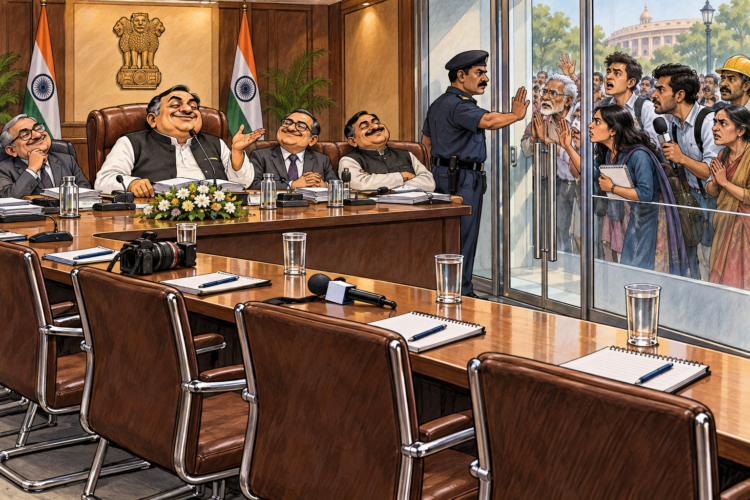
“Sir, there is a journalist at the door!”
“Tell him we have already issued the press release.”
“He wants to attend the Press Council meeting, sir.”
“Why?”
“He says he is a journalist.”
“How inconvenient! Does he also expect us to invite farmers when we discuss farming?”
I imagined this conversation while reading that the Press Council of India, our media watchdog, has been functioning without a single working journalist or newspaper editor among its members. Thirteen seats meant for them remain empty, with their nominated names awaiting formal notification.
What a splendid arrangement! A watchdog whose bark can be discussed without anybody familiar with barking being present.
“Any objections?” asks the chairman.
The thirteen chairs remain silent.
“Excellent! Unanimous agreement!”
Perhaps we should extend this model. Hospitals could function without doctors. Orchestras could dispense with musicians. Cricket teams could leave batsmen at home and send the advertising department out to face the bowling.
“We know what the batsman needs,” an executive would announce.
“A helmet?”
“No. A stronger brand identity.”
But behind these empty chairs sits something considerably less amusing.
The press is the voice of the people. It carries the complaint of the pensioner, the cry of the assaulted woman, the anger of the unemployed graduate and the question the powerful would prefer nobody asked.
Yet the attitude increasingly seems to be, “Why should people need a voice? We speak for them!”
“But sir, they are saying something different.”
“Then they have misunderstood their own needs.”
It is an extraordinary confidence. The citizen thinks he needs employment. Somebody explains that he needs patience. He asks for safety. He receives reassurance. He asks a question. He is given a speech.
And should he persist, his patriotism may suddenly require examination.
Imagine telling your wife, “Darling, there is no need for you to speak. I know exactly what you feel.”
You would discover very quickly that blocking an outlet does not eliminate pressure. It merely changes where the pressure emerges.
A government should understand that lesson before the pressure cooker does.
When grievances find space in newspapers, they can be heard, examined and answered. When those channels narrow, frustration searches for another opening. Today it’s the streets, or Jantar Mantar!
Then comes the astonished question: “Why are these people protesting?”
Listening is part of governing. Citizens do not surrender their right to speak when they cast their votes. They appoint representatives, not ventriloquists.
And a council entrusted with protecting the press should surely include people who know what happens when a reporter asks an uncomfortable question.
Those thirteen empty chairs deserve occupants, and the country deserves ears willing to listen.
Because an empty chair may never question the government.
But the people whose voices belong in it eventually will.
And when power keeps shutting the door on their words, it should not look surprised when those words gather outside its gates and become a roar..!
———————————-
Become an author… Click here
————————————-
Would love to hear from you in the COMMENTS section below…and IF YOU WANT TO RECEIVE BOB’S BANTER EVERYDAY, PLEASE SEND YOUR NAME AND WHATSAPP PHONE NO TO [email protected]
————————————————–





 Robert Clements is a newspaper columnist and writes a daily column, which has graced the pages of over 60 newspapers and magazines, from a daily column in the Khaleej Times, Dubai, the Morning Star, London, and in nearly every state in India, from The Statesman in Kolkata, to the Kashmir Times in Kashmir to the Trinity Mirror in Chennai.
Extraordinary present situation of our nation. May this uproar be fully successful! Our cries have reached Heaven and surely we will see the results! Halleluyah! AMEN!
An eye opener! Such a mess it seems. An attempt to bury the truth
It’s a messed up nation today…