

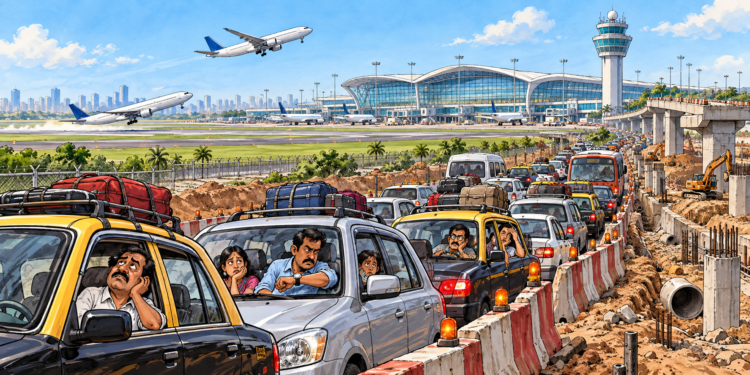
“Today’s inconvenience, tomorrow’s comfort!” announced the board beside a road that had apparently resigned from being a road.
“How reassuring,” I told the gentleman standing beside me.
He was trying to retrieve his shoe from the mud.
“For whom?” he asked.
“For tomorrow’s people.”
“What about today’s people?” we shouted together.
In India, we have become experts at travelling into the future. Every journey that once took twenty minutes now takes enough time to reconsider your career, your marriage and whether civilisation was a good idea.
But we must be patient.
Comfort is coming.
Unfortunately, nobody has supplied its arrival time.
In Mumbai, they have a new airport many miles away. Airports are wonderful things. They allow you to escape a city, provided the city first allows you to reach the airport.
“Your flight takes two hours,” says the travel agent.
“And getting there?”
“That depends on which generation of your family begins the journey.”
Surely, before opening something grand, we could make reaching it reasonably comfortable?
Build the connecting roads. Arrange reliable transport. Create sensible routes. Let passengers arrive carrying luggage instead of grievances.
But that would require a dangerous change in their planning as they would have to think about the citizen before thinking about the ceremony.
“Sir,” says an engineer, “the access road is unfinished.”
“Is the ribbon ready?”
“Yes, sir.”
“Then the project is ready.”
I sometimes imagine inviting these planners home for dinner.
“Welcome!” I would announce.
“Where is the staircase?”
“Under construction.”
“How do we reach your flat?”
“Today’s inconvenience, tomorrow’s comfort!”
“But we are hungry today.”
“Such negativity! Think of the magnificent dining experience your grandchildren will enjoy.”
That, dear planners, is precisely our complaint.
We live today. Our children attend school today. Our elderly parents need hospitals today. Our businesses require customers today. An ambulance cannot tell a patient, “Keep breathing until the road is completed.”
And some of us, inconveniently, may not be here tomorrow, so, could we receive a little consideration before becoming photographs with garlands?
Nobody is asking you to abandon infrastructure. Build it. Build plenty. But when you dig up a road, provide another usable route first. When you close a bridge, arrange a crossing. When you announce an airport, connect it.
Progress should have a working diversion.
Of course, whenever another enormous project appears, we also know whose fortunes will rise faster than its pillars. So with such great incentives, remember, your responsibility is to improve our present as you improve yours.
So get on with it, dear sirs, finish the alternative road before bringing in the bulldozer.
Give us a route before giving us a speech. And remember, when you ask us to bear today’s inconvenience for tomorrow’s comfort, we would like some assurance that the comfort belongs to us too.
Because we are citizens, sir, not construction debris..!
———————————-
Become an author… Click here
————————————-
Would love to hear from you in the COMMENTS section below…and IF YOU WANT TO RECEIVE BOB’S BANTER EVERYDAY, PLEASE SEND YOUR NAME AND WHATSAPP PHONE NO TO [email protected]
————————————————–







 Robert Clements is a newspaper columnist and writes a daily column, which has graced the pages of over 60 newspapers and magazines, from a daily column in the Khaleej Times, Dubai, the Morning Star, London, and in nearly every state in India, from The Statesman in Kolkata, to the Kashmir Times in Kashmir to the Trinity Mirror in Chennai.

Humour at its best!
You had me chuckling from beginning to end!
You’ve called a spade,a spade.Well written!
Well expresses the thots & sentiments of innumerable citizens across every city in India
Absolutely brilliant! Every line strikes a chord because it speaks of an inconvenience we have all endured, a frustration we have all felt, and a truth we have all wished someone would say aloud. What makes this piece so powerful is the way humour becomes a vehicle for an uncomfortable truth. We laugh at the absurdity, but beneath the laughter lies the exhaustion of ordinary citizens constantly asked to sacrifice their present for a future that never quite arrives.
The satire is sharp, the imagery relatable, and the imaginary conversations with the planners are simply priceless. Yet, beneath the wit lies a deeply human plea for dignity, consideration, and accountability. The line about an ambulance asking a patient to keep breathing until the road is completed is particularly resonant.
And that final punch—_“We are citizens, sir, not construction debris!”_ —lands with devastating precision. This is more than brilliant writing; it gives the public’s unspoken exasperation a voice, its patience a limit, and its grievances a punchline that refuses to be forgotten. It leaves us smiling at the satire, seething at the reality, and wondering why basic consideration still feels like a luxury.
Bob, “tomorrow never comes”.