

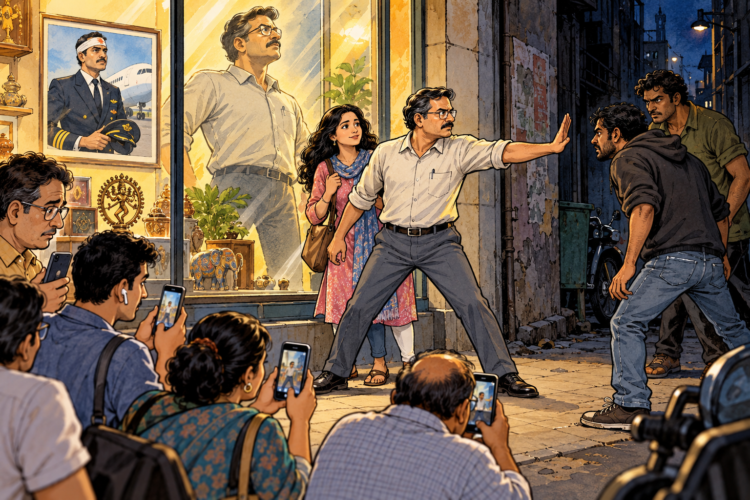
“Wanted,” I announced, “brave Indians for immediate placement at strategic locations!”
“Security guards?” asked my neighbour.
“Heroes!”
“For a film? My nephew has six packs and no expressions.”
The nation is rightly proud of Captain Smit Machchhar, who, despite serious injuries, opened his cockpit door, allowing others to intervene and help avert disaster. Prime Minister Modi spoke to him by video call and praised his courage. Here was a man who thought about saving others while fighting for his own life.
But as we applaud him, I wonder whether some of our excitement comes from how seldom we practise the courage we admire.
With so many Indians available. One point four billion right, surely we could spare a few for heroic duties?
“Where would you station them?” asked my neighbour.
“In dark lanes where women are harassed.”
“What would they do?”
“Intervene. Raise an alarm. Summon help.”
He looked worried. “Usually we summon our camera.”
“Yes. Our fingers have become extraordinarily brave. The rest of us waits for somebody else to act.”
I suggested another strategic location.
“Outside resorts where MPs and MLAs are taken when their political loyalties suddenly require medical supervision.”
“Medical supervision?”
“Yes. Their consciences develop complications. Doctors prescribe isolation from voters and regular injections of ministerial ambition.”
“And your hero?”
“He intercepts the approaching suitcase of cash.”
“What a headline!” exclaimed my neighbour. “‘POACHING ATTEMPT THWARTED!’”
“Exactly!”
“Will the Prime Minister telephone him?”
“I suspect his telephone or teleprompter might stop working altogether that day.”
We imagined the scene.
“Stand aside!” orders the political agent. “This honourable member wishes to follow his conscience.”
“Then why are you carrying it in a suitcase?” asks our volunteer.
The member looks offended. “I am doing this for my constituency.”
“Wonderful. Shall we ring your constituents and tell them?”
At this point, several powerful people discover an urgent need to leave.
We could also place heroes inside offices where someone demands a bribe, outside schools where cheating is encouraged, and beside dinner tables where hateful talk receives approving laughter.
“Such small assignments?” asks my neighbour.
Small? Try telling your own friends they are wrong. Watch how quickly your invitation to dinner disappears.
Gandhiji challenged an empire with extraordinary moral courage, alongside countless others who struggled for our freedom. Yet some who enjoy that freedom today find belittling him easier than following his example.
Captain Machchhar opened a cockpit door while bleeding, so others could live. Surely we can open our mouths when someone is being threatened, cheated or silenced?
Our youth need heroes whose courage survives after the cameras leave. Men and women who will risk their comfort, their position, even their popularity to protect another person.
“Where will you place your first volunteer?” asks my neighbour.
I point towards his mirror.
“Right there!”
Because a nation of 1.4 billion cannot keep waiting for one wounded pilot to show us what a backbone is for..!
———————————-
Become an author… Click here
————————————-
Would love to hear from you in the COMMENTS section below…and IF YOU WANT TO RECEIVE BOB’S BANTER EVERYDAY, PLEASE SEND YOUR NAME AND WHATSAPP PHONE NO TO [email protected]
————————————————–




 Robert Clements is a newspaper columnist and writes a daily column, which has graced the pages of over 60 newspapers and magazines, from a daily column in the Khaleej Times, Dubai, the Morning Star, London, and in nearly every state in India, from The Statesman in Kolkata, to the Kashmir Times in Kashmir to the Trinity Mirror in Chennai.

What an analogy.?!
Be it exactly so as written!
We have our heroes not that we don’t, hordes of them. At the same time these heroes (both male and female) have families whose safety they fear, and when the safety and responsibilities enter into the door then the better part of valour is to simmer in silence. A scene from the movie Surya the awakening between Salim Ghouse and Amrish Puri, where Salim is so helpless in front of Amrish that he wipes his dirty feet on the spotless floor to show his anger. It’s a scene that stays in your mind
Even as a child, I used to wonder why India, with its enormous population, struggled to win medals at the Olympics. We have made remarkable progress on the international stage, but when you look at the numbers, those who reach the podium are still a tiny fraction of 1.4 billion people.
Perhaps that is what makes your piece so powerful. We are quick to celebrate the extraordinary hero—the one courageous act that makes headlines, fills our screens and gives us something to applaud. But courage is not meant to be reserved for extraordinary moments.
What troubles me more is what happens behind closed doors and inside polished glass offices, where wrongdoing often survives because the rest of us choose not to see, hear or speak.
We have, in some ways, perfected Gandhiji’s three monkeys: we see injustice and look away, hear corruption and remain silent, and know the truth but refuse to speak.
Maybe the real heroes are not those who perform one spectacular act of courage, but ordinary people who choose integrity every single day—even when there are no cameras watching.