

“Who put these two reports together?” I asked, staring at the front page of yesterday’s national daily.
“A subeditor,” said my neighbour.
“Give him an award!”
“For journalism?”
“For making two news reports cross examine each other!”
There they were, sharing a box. Nandan Nilekani suggesting that examination questions be generated shortly before the examination to prevent paper leaks. Beside him, the Prime Minister speaking about India as a trusted ally.
I nearly spilt my tea.
One report discussed how to stop people cheating. The other asked people to trust us.
What a marriage! Somewhere in that newspaper office, a subeditor had introduced the bride to the groom without checking whether they were already fighting.
“Perhaps he was saving space,” said my neighbour.
“He certainly saved me the trouble of turning to the cartoons!”
Imagine the conversation inside that little box.
“Trust us!” announces one report.
“Please generate the questions at the last minute,” replies the other. “We cannot trust what happens beforehand!”
“India is dependable!”
“Excellent. Now hide the examination paper until the candidates are seated!”
Of course, Nilekani’s suggestion deserves consideration. If technology can close an avenue for cheating, use it. Students who have spent months studying deserve something better than discovering that somebody else spent ten minutes buying their future.
But what a commentary on our condition that we must shorten the life of a question paper because honesty cannot apparently survive its overnight stay.
“Where will you keep the paper?” asks the examiner.
“In a strongroom.”
“And the key?”
“With a trustworthy official.”
“And the official?”
There is an uncomfortable silence.
Perhaps we need another strongroom.
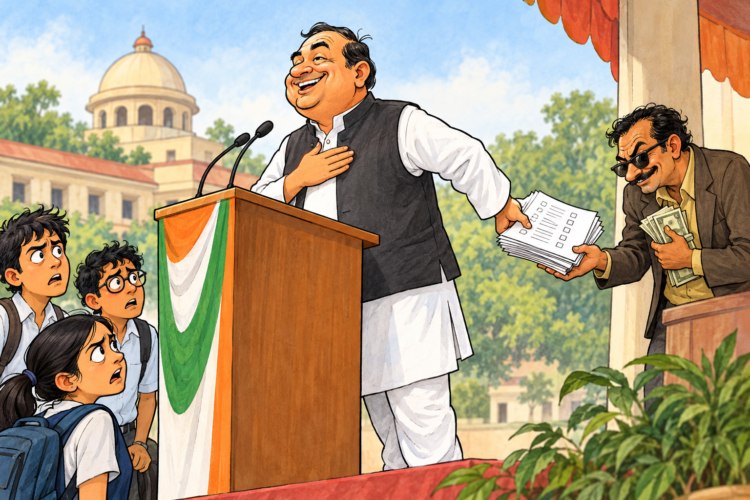
Trust, dear reader, is a peculiar commodity. Governments can print advertisements proclaiming it, leaders can announce it from magnificent stages, and enthusiastic supporters can forward it before breakfast. Yet it stubbornly refuses to materialise merely because someone has ordered a larger microphone.
An actor can look heartbroken without losing anything. He can look honest while playing a crook. A convincing face is part of his profession.
Unfortunately, citizens sometimes confuse a convincing performance with a trustworthy administration.
“Look at his expression!” says my neighbour.
“I would rather look at the results.”
“Listen to his confidence!”
“I would rather listen to the student whose examination has been cancelled.”
There is nothing contradictory about wanting India to be trusted abroad while repairing its institutions at home. But the repairs must be real. Accountability must follow failure. Promises must survive beyond the speech.
Otherwise, “Trust us” becomes the political equivalent of the shopkeeper saying, “Original product, sir!” while carefully concealing the label.
Perhaps that subeditor made an innocent arrangement. Perhaps he simply had two reports and one available box.
Either way, he placed a useful examination before the government.
Can you earn at home the trust you advertise abroad?
No leaked answer will help with this one. No smiling photograph will earn extra marks.
And please, gentlemen, do not ask the subeditor to rearrange the reports.
Rearrange the conduct that made them look so funny together..!
———————————-
Become an author… Click here
————————————-
Would love to hear from you in the COMMENTS section below…and IF YOU WANT TO RECEIVE BOB’S BANTER EVERYDAY, PLEASE SEND YOUR NAME AND WHATSAPP PHONE NO TO [email protected]
————————————————–





 Robert Clements is a newspaper columnist and writes a daily column, which has graced the pages of over 60 newspapers and magazines, from a daily column in the Khaleej Times, Dubai, the Morning Star, London, and in nearly every state in India, from The Statesman in Kolkata, to the Kashmir Times in Kashmir to the Trinity Mirror in Chennai.

God be merciful and send real repentance that our nation will survive in the coming days. In Jesus mighty name. AMEN!
Thank you Meena.
Pictures speak louder than words. The pic posted before the article says it all.
Thank you Bob for the daily enlightening dose.
I wish the Supreme Court Judges the P M , the President , the CEC & most of all Amid Sha the Home Minister get to read this & pray that God gives them grace to recognise the relevance . May God bless us all.
I wish the Supreme Court Judges the P M , the President , the CEC & most of all Amid Sha the Home Minister get to read this & pray that God gives them grace to recognise the relevance . May God bless us all.
What makes this piece so powerful is the ingenious use of something as seemingly insignificant as the placement of two news reports on a newspaper page to expose something far more consequential: the crisis of integrity in public life. The juxtaposition becomes a mirror held up to our times, revealing the uncomfortable distance between the trust we demand and the honesty we practise. The satire is sharp without being shrill, and its humour carries the weight of a serious indictment. What begins as an amusing observation about a subeditor’s arrangement gradually unfolds into a searching examination of institutional credibility, political accountability, and the fragile foundations of public trust. The brilliance lies in making the reader laugh first and reflect thereafter. Ultimately, the piece reminds us that integrity cannot be manufactured through slogans, appearances, or carefully orchestrated narratives. It must be demonstrated through conduct. A small editorial coincidence becomes a striking commentary on a much larger national concern.