

Somewhere in Mumbai, a man collapses on a crowded railway platform.
Thousands hurry past because the 8.43 fast local is more important than a human being.
In Bengaluru, a delivery rider lies bleeding after an accident while motorists carefully steer around him as though he were just another pothole. Somebody films the scene. Another uploads it. Within minutes it is trending.
In Chennai, an elderly woman falls on a busy pavement. People stare, whisper, slow down for a better look, then continue with their shopping.
This is not fiction.
This is us.
We are becoming a nation that records suffering instead of relieving it.
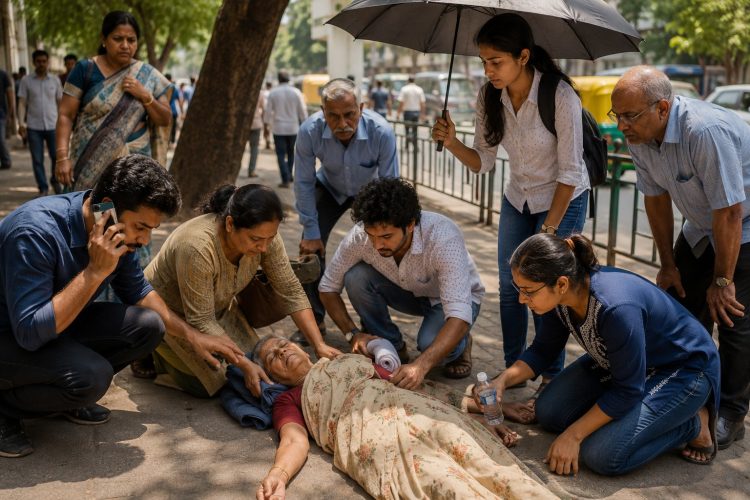
Then I read an incident related by Alyson Kieda from another part of the world that made me both smile and hang my head in shame. An elderly woman had collapsed unconscious on a scorching footpath after a bad fall. Within seconds strangers rushed to help. One called emergency services. Another placed a coat beneath her head. Someone gently tucked towels beneath her arms. Yet another stood holding an umbrella over her until the ambulance arrived. They were young and old, from different communities and backgrounds, yet they worked together as though she were their own mother.
Nobody asked who she voted for.
Nobody asked her religion.
Nobody asked whether helping her would make them late for work.
They simply helped.
When did we Indians become so emotionally bankrupt?
Yes, we are building magnificent metros, gleaming airports, coastal roads, flyovers and expressways. But somewhere along the way we are forgetting to build compassionate citizens.
Our cities have become bigger.
Our hearts have become smaller.
Every day there are stories of accident victims waiting precious minutes because nobody wants to get involved. We see women being harassed and people quietly walking away. We see old people struggling to cross roads while healthy youngsters march past staring into their mobile phones. We have become experts at saying, “Somebody should help.”
That somebody is always someone else.
Two thousand years ago an expert in Jewish law asked Jesus, “Who is my neighbour?”
Jesus answered with the story of the Good Samaritan. A wounded man lay by the roadside. A priest walked past. A Levite walked past. Both were religious men. Both were too busy. Both probably had excellent excuses.
Then came a Samaritan, a man belonging to a community despised by the Jews. He stopped, treated the stranger’s wounds, carried him to safety and paid for his care.
Jesus then asked, “Who was the neighbour?”
The answer was obvious.
“The one who had mercy on him.”
Then Jesus gave a command that India desperately needs to hear today.
“Go and do likewise.”
The next time you see someone in distress, do not become another spectator with a smartphone.
Become the Samaritan.
Because the measure of a great nation is not how many expressways it builds. It is how quickly one stranger bends down to help another.
So let’s make our nation great by doing just that..!
———————————–
Become an author… Click here
————————————-
Would love to hear from you in the COMMENTS section below…and IF YOU WANT TO RECEIVE BOB’S BANTER EVERYDAY, PLEASE SEND YOUR NAME AND WHATSAPP PHONE NO TO [email protected]
————————————————–






 Robert Clements is a newspaper columnist and writes a daily column, which has graced the pages of over 60 newspapers and magazines, from a daily column in the Khaleej Times, Dubai, the Morning Star, London, and in nearly every state in India, from The Statesman in Kolkata, to the Kashmir Times in Kashmir to the Trinity Mirror in Chennai.
Not what I have experienced in Blr. People do rush in to assist
Inspiring
Wow !
We as a nation needs to become the Good Samaritan to our neighbours we have got too much hate in us.
Yes. We must get involved with doing small acts of good
Sad but true. India is no longer what it used to be. Fear of getting involved, maybe consequences as well, keep people looking the other way.
Creating sensational videos is gaining over a fine tuned conscience!
Yes, a true drought of emotions has hit us of late!
Showing compassion to those in need is heavenly. Thanks for highlighting the same.
We’ve become selfish. We look into us. We’ve put intentional blinkers. We hate misery. We love only those people who entertain us. We’ve turned rigid and inflexible in our attitude. The Good Samaritan is just a ‘Once-Upon-a -Time’ story for us.
We need to flip ourselves up.
Article was very nicely built up.
India has started deteriorating… Sad