

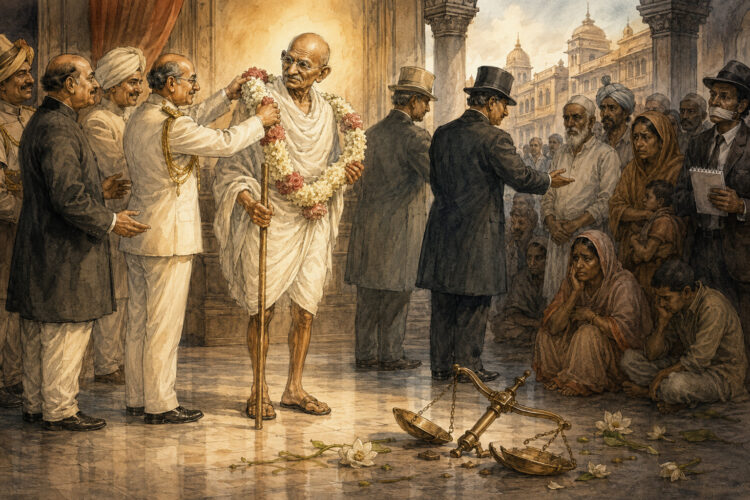
As I travel all over the world, something that those abroad associate me an Indian with, is with peace and Gandhiji. It’s certainly a wonderful association, but I wonder whether the people at home are bent on destroying that image:
“Sir, we are giving away the Gandhi Peace Prize!” say those at home.
“How wonderful,” I said. “And where is Gandhi?”
There was an uncomfortable silence.
“His portrait is on the wall,” whispered an official.
I looked at the portrait. Gandhi appeared thinner than usual. Perhaps even his photograph had begun fasting in protest.
The Government of India instituted the Gandhi Peace Prize to honour individuals and organisations committed to nonviolence, harmony and social transformation. Distinguished people from across the world have received it. They come to India, speak about peace, bow before Gandhi’s memory and return home carrying a handsome citation.
Meanwhile, Gandhi remains hanging on the wall, wondering when his teachings will receive the award.
It is quite easy to honour a dead Gandhi. He does not interrupt speeches. He does not ask uncomfortable questions. He does not organise a march against injustice. He does not stand beside the frightened minority, defend the silenced journalist or ask rulers why dissent has suddenly become disloyalty.
A living Gandhi would be terribly inconvenient.
He might walk into Parliament wearing that little dhoti and ask why religion is being used to divide the nation he struggled to unite. He might visit a television studio and request the anchors to stop shouting. The anchors would immediately shout, “Why are you against freedom of expression?”
He might sit with protesting citizens and listen to them. This could be dangerous because listening is nowadays considered weaker than lecturing.
He might even ask why his assassin is being glorified by some while his own ideals are quietly assassinated every day.
The police would probably stop him.
“Name?”
“Mohandas Karamchand Gandhi.”
“Occupation?”
“Seeking truth.”
“Suspicious activity,” the officer might write.
And yet, every October, leaders garland his statue. Cameras click. Heads bow. Speeches praise his courage. Then everybody returns to work and carefully avoids everything he stood for.
We have reduced Gandhi to currency notes, cleanliness campaigns, statues and awards. His spectacles are used as a logo, but nobody wants to look at India through them.
Through those spectacles we might see the poor, the persecuted, the powerless and those afraid to speak. We might discover that patriotism is not proved by shouting loudly, but by protecting every Indian quietly.
The Gandhi Peace Prize is a noble honour. But the greatest prize we could offer Gandhi would be a nation that still practises his principles.
Garlanding Gandhi is easy.
Following him is not.
Perhaps before presenting the next international award in his name, our rulers should ask whether Gandhi himself would accept an award from them.
I suspect he would smile gently, return the citation and ask for his India back…!
———————————–
Become an author… Click here
————————————-
Would love to hear from you in the COMMENTS section below…and IF YOU WANT TO RECEIVE BOB’S BANTER EVERYDAY, PLEASE SEND YOUR NAME AND WHATSAPP PHONE NO TO [email protected]
————————————————–





 Robert Clements is a newspaper columnist and writes a daily column, which has graced the pages of over 60 newspapers and magazines, from a daily column in the Khaleej Times, Dubai, the Morning Star, London, and in nearly every state in India, from The Statesman in Kolkata, to the Kashmir Times in Kashmir to the Trinity Mirror in Chennai.
Is somebody reading this?