

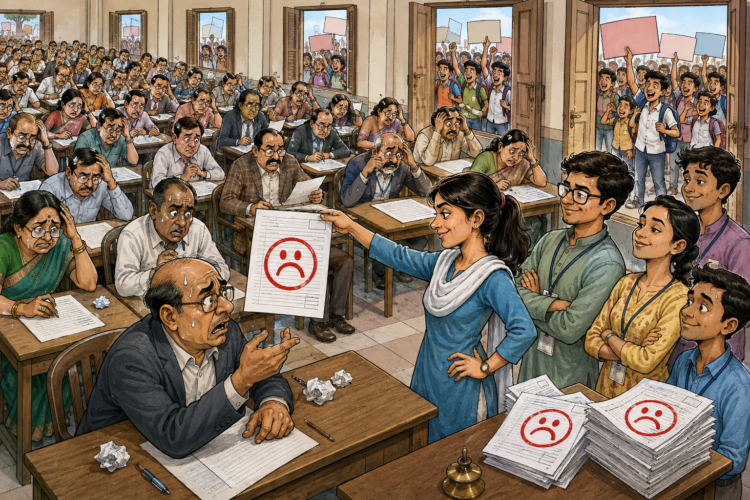
Six hundred examiners entered the examination hall. Unfortunately, the examination body failed all of them.
The NTA has reportedly removed six hundred experts following examination controversies and ordered multiple layers of checking. NTA stands for the National Testing Agency. It is an organisation established by the Government of India to conduct major entrance and eligibility examinations, including NEET, JEE Main, CUET and UGC NET.
This is excellent news. Until now, only students were expected to pass examinations. At last, the examiners have been asked to sit for one.
I imagine the question paper was difficult.
Question One: If a student studies for two years, spends his parents’ savings on coaching, travels four hundred kilometres to an examination centre, and then discovers that the paper was leaked, calculate the speed at which his faith in the system disappears.
The experts probably asked for extra sheets.
Question Two: A government says the examination is fair. Ten thousand students say it is not. Police arrive and remove the students. Who has passed the test?
The official answer was probably, “The police.”
Outside, the students were agitating. Some had slept on pavements. Some had gone hungry. Some had been dragged away for demanding what should never have required a protest: an honest examination.
Inside, a committee may have been studying the matter. In India, whenever a problem becomes too large to solve, we give it chairs, tea, biscuits and a committee room. By the time the report appears, the students have grown old enough to apply for the committee.
Now six hundred experts have been removed. That is a very large number. One wonders whether the NTA employed experts or organised a wedding reception. Did nobody notice that six hundred people were needed to produce one trustworthy question paper?
Perhaps expertise had become like examination marks. The more you printed, the more impressive it looked.
Multiple layers of checking have now been introduced. Wonderful. We shall have a checker, a checker of the checker, and a senior checker who checks whether the first two checkers checked. If anything still goes wrong, another committee will check why all the checking remained unchecked.
The students were not asking for grace marks. They were asking the nation to keep its word. Yet the answer they received was barricades, batons, silence and assurances from committees.
But behind the joke stands an angry young student holding a useless admit card and asking a serious question: “Can I trust you?”
That question is larger than the NTA. An examination does more than measure knowledge. It creates a promise of competence. A certificate carries that promise into the world. Examination fraud breaks that promise.
Before examining our children again, let the system answer one final question.
How is it, that it required agitating students for this government to finally realise after twelve years that they had six hundred misfits working as examiners?
———————————–
Become an author… Click here
————————————-
Would love to hear from you in the COMMENTS section below…and IF YOU WANT TO RECEIVE BOB’S BANTER EVERYDAY, PLEASE SEND YOUR NAME AND WHATSAPP PHONE NO TO [email protected]
————————————————–




 Robert Clements is a newspaper columnist and writes a daily column, which has graced the pages of over 60 newspapers and magazines, from a daily column in the Khaleej Times, Dubai, the Morning Star, London, and in nearly every state in India, from The Statesman in Kolkata, to the Kashmir Times in Kashmir to the Trinity Mirror in Chennai.
The problem lies not in any system or setup. It lies in the. Character of our people. When greed and dishonesty combine the result is a corrosive mixture that will eat through anything.
I believe the only solution could be that perhaps 200 – 250 standard questions are set and a random computer generated selection of 30 – 35 questions are printed out for each student on the morning of the exam at the centre itself. So students sitting next to each other could not even cheat from each other
The 250 questions would cover the entire syllabus and could be announced in advance so students could prepare.
This idea was shared by Abhijit Mitra Iyer on a show. I think it would work.
Dishonesty, greed and lies requires many layers and cover-ups! That, Unfortunately is the scenario today. Whether it’s exam paper leaks, spurious medicines, adulterated food etc. The honourable few seem to be in a very small minority!
A point, perhaps its an aside but I believe relevant. When I was in school more than 40 years ago some students would take old question papers mix them up and make models of them and then sell them as leaked SSC papers and they had buyers who bought the ‘leaked papers’ for hundreds of rupees. The point is when you have sellers you have buyers.
As a Doctor, I think like the Architecture entrance- NATA, NEET should also be conducted multiple times atleast 3 times- & best of the 3 could be taken for applying.
NEET PG exam should be atleast 6monthly as fully graduated MBBS Doctors are wasting their years to become A Specialists when there r shortage of doctors in each & every dept while doing PG & the PG students overburdened with work till the next batch comes in to help them with work.
For a Medical seat, a student studies the whole year , one cannot judge her/his knowledge or capabilities in just one exam which determines her/his whole destiny.
There should also be questions to determine his attitude & approach in cases to judge his empathy towards human life without distinguishing classes of patients- attitude of doctors towards rich or poor should be the same..
There’s Adulteration in Everything now…
(And, somewhere, Adultery in relationships has taken a back seat… )