

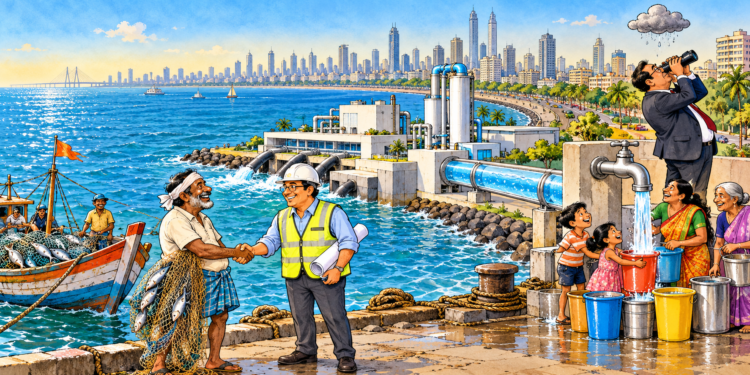
“Any news?” asked the businessman, looking anxiously out of his office window.
“Stock market, sir?”
“Clouds!”
And there you have Mumbai, the financial capital of India, where men can predict international markets, manipulate balance sheets and arrange billion rupee mergers, but must finally look upwards and ask, “Will it rain?”
Our economic powerhouse runs on an arrangement with the monsoon. An annual understanding that the clouds will kindly remember our address.
Meanwhile, beside us lies the Arabian Sea. Water everywhere, while we peer into empty buckets.
It is rather like starving outside a restaurant because nobody has figured out how to open the door.
Now Mumbai’s Manori desalination project proposes to turn seawater into drinking water, with an initial capacity of 200 million litres daily.
Naturally, there are protests. Fishermen fear damage to their livelihood and the marine environment. Those concerns deserve answers, safeguards and proper protection. A fisherman cannot feed his family on a municipal assurance printed on expensive paper.
But once those concerns are properly addressed, must every solution remain permanently anchored offshore?
I am reminded of a story written by Goan columnist Blaise Costabir, about Inacio, whose village, Curdi, was lost to the Salaulim Dam.
A journalist hopes to stir his anger.
Surely there is bitterness? Surely there is a grievance waiting to become a headline?
But Inacio sees something beyond his submerged village. The dam supplies water to a vast section of Goa. His loss has helped others live.
Imagine the journalist’s disappointment.
A man offered the opportunity to become tomorrow’s angry headline has chosen instead to think about tomorrow’s thirsty families.
What an inconvenient fellow!
Today, we have become experts at supporting progress somewhere else.
I have used Mumbai, as just an example. But all over the country, we want taps that flow, switches that work and roads that move, provided every inconvenience is delivered to somebody else’s doorstep.
Yes, trees matter. Yes, fishing communities matter. And yes, millions of people needing dependable drinking water matter too.
The difficult business of governing is to bring these needs together, using sound science, fair compensation and promises that survive the ribbon cutting ceremony.
The difficult business of citizenship is to admit that our own interest cannot always occupy the entire dining table.
In Blaise Costabir’s story, Inacio had lost something precious. Yet he could see the people who had gained something essential.
That requires a generosity no protest slogan can manufacture.
Let affected families receive protection they can actually depend upon. Then let us also find the courage to support a necessary project that serves everybody.
Because the greater common good demands something from all of us.
From governments, honesty. From citizens, perspective.
And from those of us who demand water every morning, an occasional willingness to help make it possible.
Otherwise, let us appoint the monsoon as our municipal commissioner.
We already depend on its attendance, and spend half the year complaining about its performance..!
———————————-
Become an author… Click here
————————————-
Would love to hear from you in the COMMENTS section below…and IF YOU WANT TO RECEIVE BOB’S BANTER EVERYDAY, PLEASE SEND YOUR NAME AND WHATSAPP PHONE NO TO [email protected]
————————————————–





 Robert Clements is a newspaper columnist and writes a daily column, which has graced the pages of over 60 newspapers and magazines, from a daily column in the Khaleej Times, Dubai, the Morning Star, London, and in nearly every state in India, from The Statesman in Kolkata, to the Kashmir Times in Kashmir to the Trinity Mirror in Chennai.