

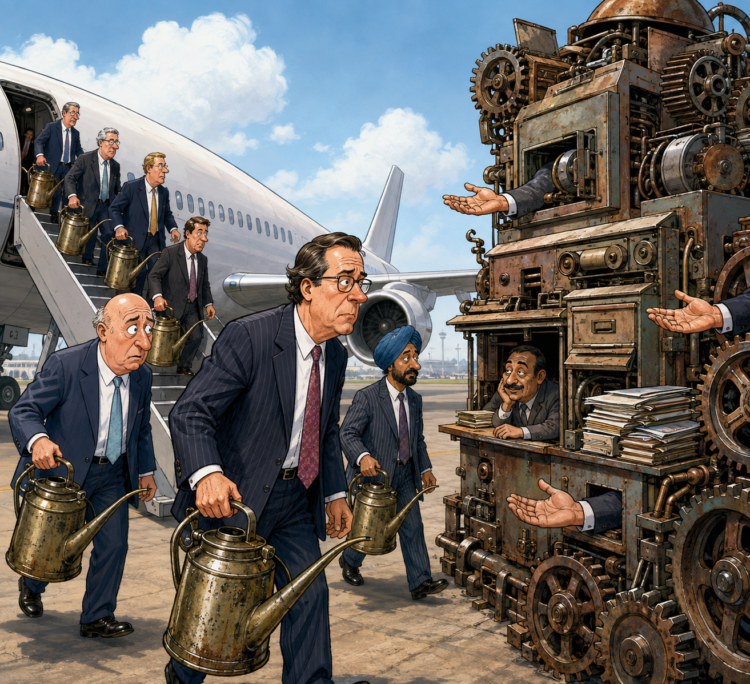
Had dinner with a top corporate leader of a multinational company in New York last night, and during our conversation I asked him a question that I thought would make me feel proud.
“Why are you not investing in India?” I asked.
I expected him to look embarrassed and admit that his company had somehow overlooked the fastest growing, most exciting, most brilliantly governed economy in the world.
Instead, he looked at me quietly.
“Your courts take decades to decide cases,” he said. “And many companies that succeed in India are Indian companies. They know how to oil the wheels.”
I wished he had spoken a little more softly.
Not because anyone else was listening, but because my conscience was.
Oil the wheels!
Was that how the world saw us?
We Indians have become expert mechanics. We know which wheel squeaks, which wheel refuses to move, and which wheel must be privately taken aside and gently lubricated with an envelope.
Foreign investors arrive with business plans, feasibility reports, capital, technology and dreams. We welcome them warmly, garland them generously and then introduce them to the machinery.
“This is the first wheel,” we explain.
“It appears stuck,” says the investor.
“Of course,” we reply proudly. “It has not been oiled.”
“And that wheel?”
“That belongs to another department. It requires a different oil.”
The poor investor soon discovers that it is not enough to carry money into India. He must also possess advanced knowledge of lubricants. He needs to know what oil is required, how much must be applied, where it must be poured, and whose palm must hold the oilcan.
What this government promised us was clean machinery. We were told the wheels would turn smoothly, honestly and efficiently. But somewhere along the way, the machinery appears to have become more complicated.
It is no longer simply a question of oiling the system. One must find out who controls the wheel, who controls the person controlling the wheel, and who should be approached to introduce you to the person who controls both.
Meanwhile, cases crawl through courts. Contracts remain disputed. Projects wait. Investors lose confidence and quietly take their money elsewhere.
Then we organise another international summit and ask why the world is not rushing in.
The world wants to rush in. It is simply afraid it may never rush out.
I felt ashamed listening to that corporate leader. Patriotism should not mean denying what others see. It should mean repairing what embarrasses us.
India does not lack talent, markets or opportunity. It lacks machinery that moves without secret lubrication.
Clean the machinery, speed up justice, punish corruption and make every wheel turn fairly.
Then investors will bring capital.
Not oilcans…!
———————————–
Become an author… Click here
————————————-
Would love to hear from you in the COMMENTS section below…and IF YOU WANT TO RECEIVE BOB’S BANTER EVERYDAY, PLEASE SEND YOUR NAME AND WHATSAPP PHONE NO TO [email protected]
————————————————–




 Robert Clements is a newspaper columnist and writes a daily column, which has graced the pages of over 60 newspapers and magazines, from a daily column in the Khaleej Times, Dubai, the Morning Star, London, and in nearly every state in India, from The Statesman in Kolkata, to the Kashmir Times in Kashmir to the Trinity Mirror in Chennai.
Well said, I mean remarked. The analogy fits in so well. When will this hypocrisy go?
On the button.
What a shame! A sad image of what can be a proud country. 😔
Somebody who works for a multinational company told me they add a buffer in their expenditure for this purpose of OILING THE WHEELS/ GREASING PALMS! personnel in India are given the task to ensure it is done🙈 invoices are naturally bumped up!
When will the level of corruption end? I am aware it exist all over the globe, but I am told it is not as bad as India.
How does that make it less difficult? Same difference????
Thank you, Bob. I enjoyed reading your article.
Commendable read.Let it be fruitful also.
Indian hypocrisy is here to stay. Unless the entire political system is changed n Gen Z with new ideas n reforms want to change the system, v can expect some change.
‘They know how to oil the wheels’ !