

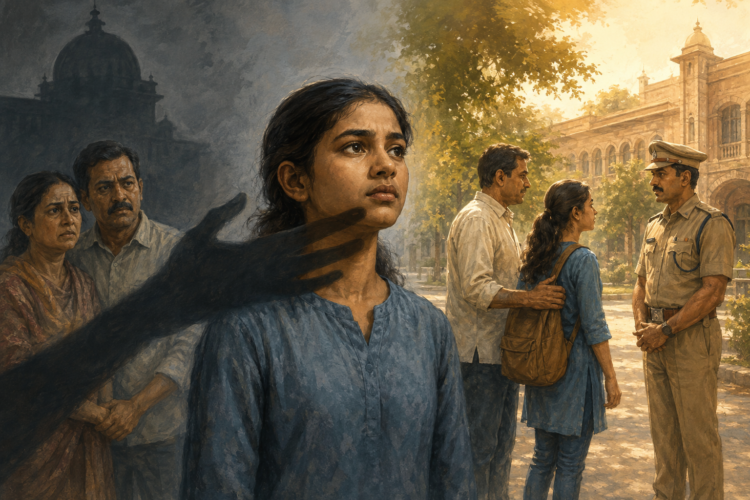
A fifteen-year-old girl uses abusive language while speaking about the Prime Minister. Immediately, the machinery of power allegedly swings into action. Threats are made against her and her family, and soon the child appears before the public saying that she was forced to use those words.
Perhaps she was. Perhaps she was not. But the larger question is whether we are listening to the anger behind those words.
A democracy should not be frightened by the language of a child. It should correct her language, listen to her grievance, and teach her that she possesses the precious right to criticise those in power.
When my elder daughter was around that age, her cellphone was stolen from her college library. Students had to deposit their bags before entering, and the phone disappeared from inside hers.
She complained to the librarian.
“I am not responsible,” said the librarian.
But she was responsible because the bag had been left in her custody.
My daughter called me. I went to the college, met the librarian, and heard exactly the same answer.
“I am not responsible!”
My daughter looked at me. Her eyes asked a question that her lips did not.
“Dad, is this how the system works? Do people in authority simply deny responsibility while ordinary people walk away helplessly?”
I could have told her to forget the phone. I could have bought her another one. That would have been easier, but it would also have taught her a terrible lesson.
So I marched with her to the nearest police station and registered a theft complaint. A policeman returned with us to the college.
Suddenly, everyone took my daughter seriously.
“Why did you have to bring the police into the college?” the principal asked me later.
“Because my daughter had to learn her rights!” I replied.
That lesson was more valuable than the cellphone. She learnt that authority can be questioned, negligence can be challenged, and an ordinary citizen need not tremble before a system.
What did that fifteen year old girl learn?
Did she learn to choose better words while bravely expressing her opinion? Or did she learn that criticism invites threats, that power must never be questioned, and that silence is safer than truth?
Our children will occasionally speak foolishly. That is why they need parents, teachers and leaders. We must correct their words without crushing their voices.
A strong democracy does not silence a child. It teaches her how to speak. A wise government does not fear the anger of its youngest citizens. It asks what produced it.
Because when we frighten a fifteen year old into silence, we are not protecting the nation.
We are frightening its future..!
———————————–
Become an author… Click here
————————————-
Would love to hear from you in the COMMENTS section below…and IF YOU WANT TO RECEIVE BOB’S BANTER EVERYDAY, PLEASE SEND YOUR NAME AND WHATSAPP PHONE NO TO [email protected]
————————————————–




 Robert Clements is a newspaper columnist and writes a daily column, which has graced the pages of over 60 newspapers and magazines, from a daily column in the Khaleej Times, Dubai, the Morning Star, London, and in nearly every state in India, from The Statesman in Kolkata, to the Kashmir Times in Kashmir to the Trinity Mirror in Chennai.
Yes. There are forces around out to suppress our rights with threats, sometimes veiled too, They want truth to be twisted to untruth. Let’s boldly counter them exercising our rights.
So true. Freedom of speech in a democracy is every citizen’s right, especially the youth who will be our future leaders.
Appalling to say the least
Worst part bring that the apology was not sufficient, the family is being threatened and hounded by police, government babus etc. This child and her mother are so cornered that they are leaving the city. This is the face of democracy… sad truth
I know the language of the girl is what a lot of people call questionable but who are we to set standards for language usage? As society has different strata and society sets standards for expected behaviour norms which include language. We have among our friend circles used colourful language hidden from our elders. Some communities use it freely even among relatives considering it part of communication without malice. The newer generation (some of them) speak their mind colourful et al. They tend to call a spade a spade as they are it and they are heavily influenced by the surroundings like movies, tv serials, comedy shows, reality tv, media and our parliamentarians. Foul language and behaviour begets foul language and behaviour. Some disguise it others amplify it. As they say “The child is the father of man” interpret it in different ways
A democracy thrives on questions, specially when they query accountability. What a wonderful lesson you taught your daughter when her phone went missing. It us upto the adults to model truth and courage in the face of apathy from those in positions of responsibility and power!
An eye opener on democracy,it’s rights&duties.Its great you could show your daughter the same.
Yes , you got the police to intervene & rightly so . But what happens when the forces to protect the citizen’s right themselves side with the powers that be or the Courts prefer to play with the aggressors. Calling the agitating youth Cocroaches and parasites caused the drama that all witnessed. Every wrong can be righted by regret, repentance and restitution. Jai Hind.
“A Wise government does not fear the anger of it’s youngest citizens “…. Well said Bob…” Wise government ” !