

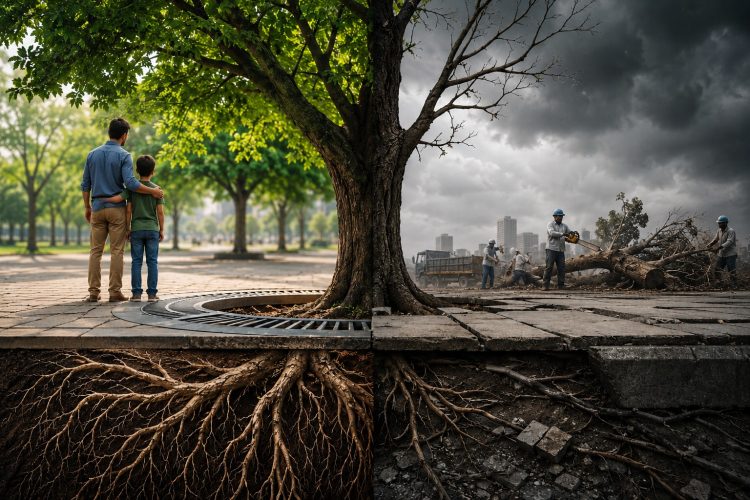
Now that the monsoons are fast approaching, our authorities have suddenly discovered trees.
All year they pass them without emotion. The trees stand there quietly, giving shade, oxygen and free beauty to people who otherwise have to stare at traffic jams and political banners. Nobody notices them. But the moment clouds gather and weather reporters start speaking dramatically about “heavy rainfall warning,” the authorities leap into action like heroes in a disaster movie.
“Dangerous trees!” they shout.
And immediately poor old trees are marked for execution.
Chainsaws appear. Men in fluorescent jackets arrive. Somebody blows a whistle importantly. Another man holds a clipboard and looks serious enough to suggest he is personally saving the nation.
But here is my question. Why are we only looking at the top of the tree? Why are we not looking at the roots?
Whenever I visit the United States I notice something beautiful. Huge trees stand proudly beside roads and pavements. Strong. Healthy. Majestic. Then I look down and understand why.
The roots are respected.
There are open spaces around them. Metal grills allow sunlight, water and air to reach below. The roots breathe. The roots spread. The roots grow deep and strong.
Here, what do we do?
We imprison the roots.
We cover them with cement, tiles and decorative pavers till the poor tree looks like it has been forced to wear tight shoes two sizes smaller. Then when heavy rains come and the weakened tree collapses, everybody points fingers at the tree itself.
Imagine doing that to human beings.
Suppose I tied your hands, blocked your nose, denied you food and then shouted, “This fellow is weak!”
That is exactly what we do to trees.
Of course, there is another issue nobody likes discussing. Money.
Ask how much money goes into cutting a tree and you may discover more branches in the operation than on the tree itself. Suddenly everybody gets a “cut” while the tree gets completely cut.
But perhaps this is not only about trees.
Perhaps it is about children too.
We are busy decorating children’s lives with expensive schools, shiny gadgets, tuition classes and motivational seminars. But what about the roots?
What about truth?
What about ethics?
What about teaching them honesty when cheating seems easier? What about teaching kindness when cruelty gets applause? What about teaching courage when silence is safer?
Because when roots are strong, storms do not destroy easily.
A child with strong roots may bend in life, may struggle, may suffer disappointment, but will not collapse at the first temptation of corruption or crime.
Maybe before cutting trees this monsoon, we should first ask ourselves a far more important question: Are we looking after the roots of both trees and our children?
____________________________
HERE’S MORE THE AUTHOR CAN OFFER YOU…. JUST CLICK HERE..
————————————————
Would love to hear from you in the COMMENTS section below…and IF YOU WANT TO RECEIVE BOB’S BANTER EVERYDAY, PLEASE SEND YOUR NAME AND WHATSAPP PHONE NO TO [email protected]
————————————————–




 Robert Clements is a newspaper columnist and writes a daily column, which has graced the pages of over 60 newspapers and magazines, from a daily column in the Khaleej Times, Dubai, the Morning Star, London, and in nearly every state in India, from The Statesman in Kolkata, to the Kashmir Times in Kashmir to the Trinity Mirror in Chennai.
Thank you Bobby.
Very true
We are so quick to cut trees! It is a pastime of practically every committee that comes in our apartment! They look at it transactionally! Yet they will celebrate world environment day! It annoys too much, this hypocrisy!
A certain number of trees, greenery is essential for atmospheric equilibrium.
Roots should be strong in order survive…
The picture heading this column says it all! The sad truth is we do not look after the Roots! Both in the case of trees and children. When children grow up bossy, demanding disrespectful or worse we seldom blame the adults responsible for teaching and leading them by example.
Roots… one’s upbringing…
This morning I posted on my FB page about a Hate comment… I question the upbringing of the person who spreads hate and discriminates….
Very true Kiran. 🙏
Amazing expression
Good question. We constantly are investing – in assets, finance, good education, even life partners and connections. What about investing in the source of all things good? For ourselves and for the sake of our future – the children?