

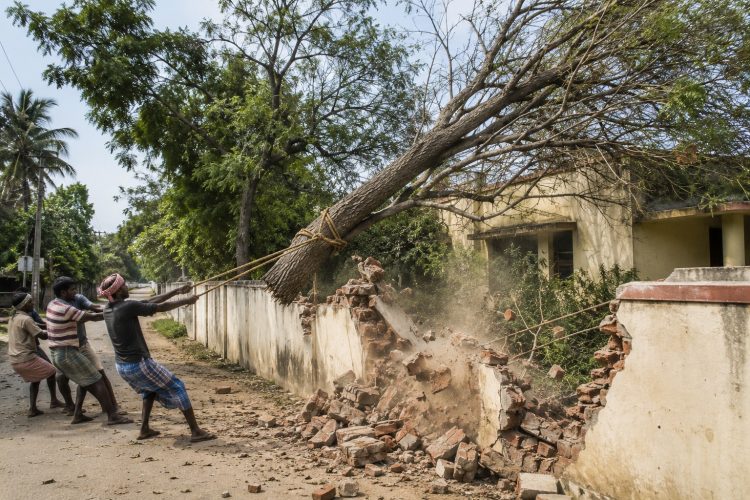
This morning I witnessed a uniquely Indian engineering philosophy. It is called, “If something else breaks while doing the job, that is somebody else’s problem.”
The tree cutters arrived to remove a dried junglee neem tree behind my house. I watched them with interest, expecting chainsaws, careful measurements, helmets and perhaps even a little planning.
Instead, they produced one rope.
The rope, apparently, was expected to perform the duties of an engineer, an architect, a crane and common sense.
I politely pointed to the old compound wall standing directly in the path of the falling tree.
“If you pull it like that,” I said, “the tree will crash onto the wall.”
The contractor looked at me as though I had insulted generations of his ancestors.
“You want everything,” he shouted. “You want the tree removed and the wall to remain standing.”
“Exactly,” I replied. “That is generally how successful tree cutting works.”
He looked genuinely puzzled.
And then he did the unexpected. He called his men and walked away without cutting the tree.
I was shocked. What he was telling me, was, “You wall is collateral damage!”
Somewhere along the way we have accepted collateral damage as a perfectly normal part of life. We expect that whenever something is repaired, something else will mysteriously stop working.
Call an electrician to fix the fan and suddenly the doorbell develops depression.
Invite a plumber to repair one leaking pipe and your bathroom tiles decide to retire.
Painters arrive to brighten your walls and leave colourful footprints across the entire house, including the dog.
Roads are dug up to lay cables. The cables are laid. The road is forgotten. Months later another department remembers it has pipes underneath and digs up the same road again with tremendous enthusiasm.
Then comes the granddaddy of collateral damage.
A flyover is built to save commuters ten minutes, while traffic below suffers for three years. Shops close, businesses collapse, pedestrians risk life and limb, and occasionally the workers themselves pay the highest price because safety was treated as an optional extra rather than part of the project.
None of this is unavoidable. It is simply the result of poor planning.
Good work is not merely completing the task. Good work is completing it without creating three new problems for somebody else.
Whether it is cutting a tree, repairing a switch, laying a road or building a bridge, the real measure of professionalism is not what you finish but what you leave untouched.
As for my tree, I still hope it comes down without bringing the wall with it.
Because replacing a tree is expensive. But replacing a wall is more expensive.
Replacing common sense, unfortunately, appears to be impossible…!
____________________________
HERE’S MORE THE AUTHOR CAN OFFER YOU…. JUST CLICK HERE..
————————————————
Would love to hear from you in the COMMENTS section below…and IF YOU WANT TO RECEIVE BOB’S BANTER EVERYDAY, PLEASE SEND YOUR NAME AND WHATSAPP PHONE NO TO [email protected]
————————————————–







 Robert Clements is a newspaper columnist and writes a daily column, which has graced the pages of over 60 newspapers and magazines, from a daily column in the Khaleej Times, Dubai, the Morning Star, London, and in nearly every state in India, from The Statesman in Kolkata, to the Kashmir Times in Kashmir to the Trinity Mirror in Chennai.
Collateral damage is par for the course! But here in Blr though the guys do a pretty decent job while cutting
Happens all the time
Absolutely right. This has become common habit amongst most of us. Dishonesty is common. Painful.
Patience&foresight is the need of the hour.
Ha ha. So true. Harsh reality of our present times.
Replacing common sense is almost impossible in a society which is blind, deaf and mute to humanity and our environment.
” Collateral Damage! ” The state of our country wherever you are and wherever you go. Money talks. Truth walks hanging it’s head in shame. Sooner rather than later I hope people will unite under a common cause for the good of all.
Planting trees that are bound to grow tall close to a neighbour’s boundary wall is a common practice. Unfortunately, it often becomes a major nuisance for the neighbour.
Good Lord ! Bob, your article is echoing all that is happening to me these days !!! Every word Resonates !!!